

Lionel Walrond FSA, FMA (1927-2020) – curator of Stroud Museum 1955-1992
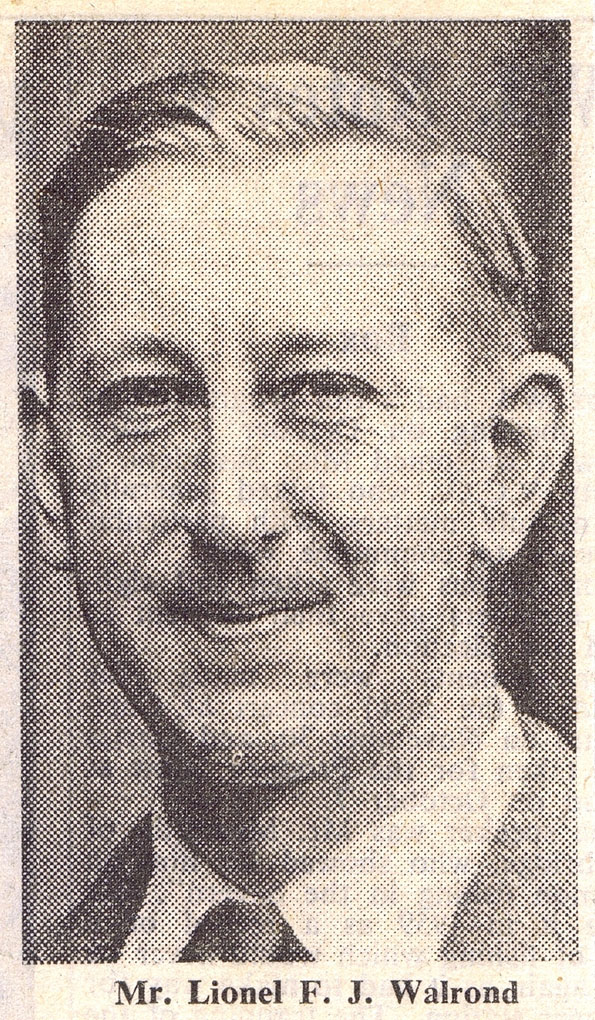
an appreciation, by Marion Hearfield of Stroud Local History Society, December 2025
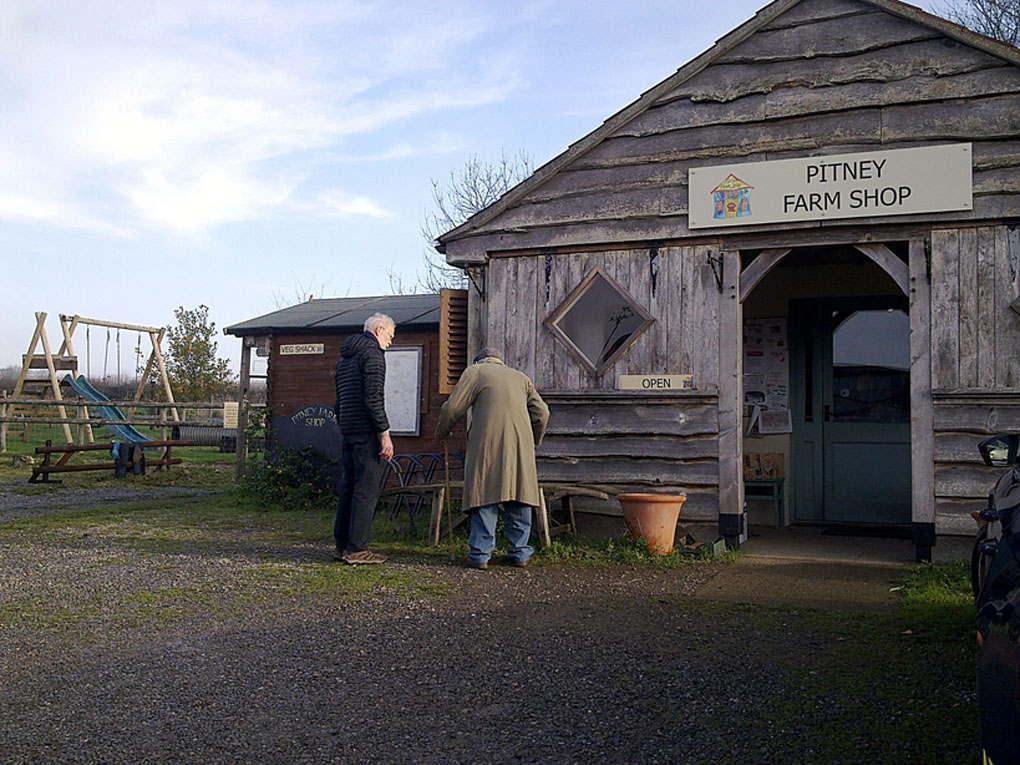
As a teenager on the family farm in Pitney, Somerset, Lionel used an old barn to store his neatly-labelled and very mixed collection of fossils, farm implements, coins, toys, boots, pottery, flints – precursor to the Stroud Museum he would curate from the age of 28. Brought up by aunts and an uncle, Lionel went to Huish Grammar School in Taunton and was determined to leave the farm.
The 1940s were the early days of academic interest in folk life and artefacts and he was tutored by men he described as its great pioneers, particularly Sir Cyril Fox (who established the Welsh Folk Museum at St Fagans) and Kenneth Hudson of Bristol University and the BBC, who wrote the first book about industrial archaeology and whose extramural adult education programmes had snared the teenage Lionel.
Still a teenager, Lionel identified as Roman tesserae several small stones turned over by a local farmer’s plough at Low Ham, just across the valley from his home in Pitney. The resulting excavation of the pavement made national news and it is displayed in Taunton museum.
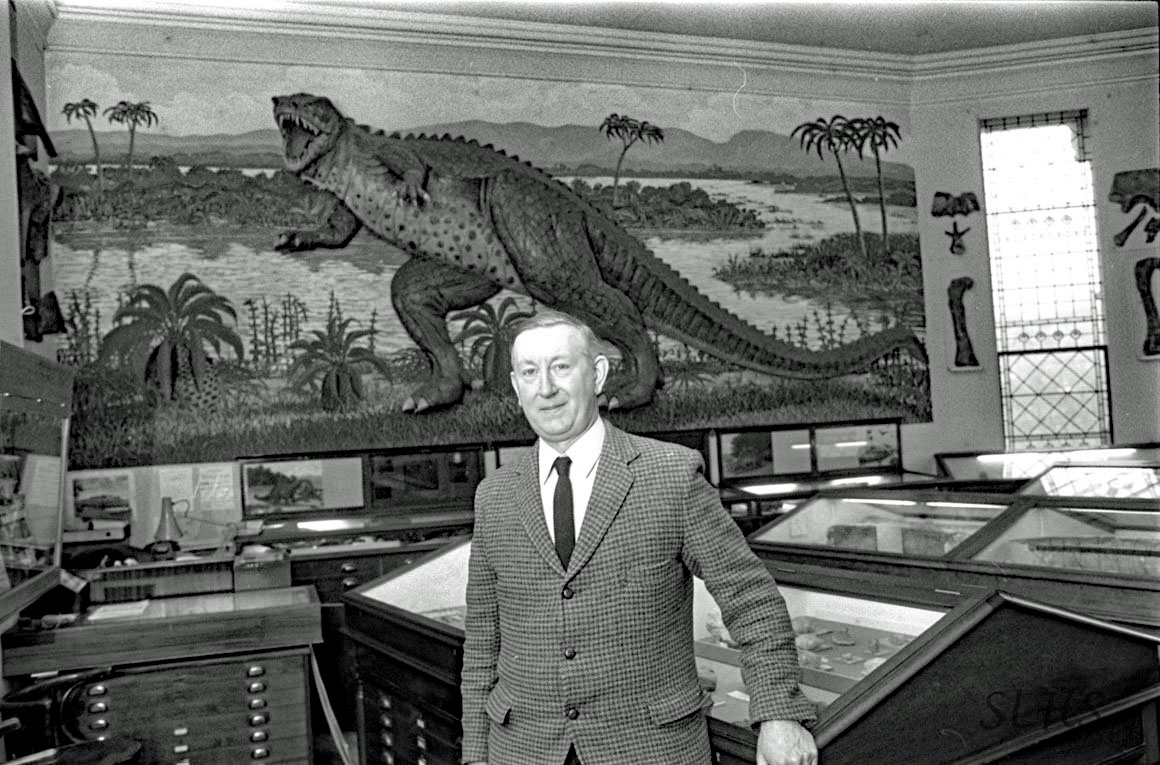
Lionel’s passion for old buildings, ancient paths and social history filled his life, the museum’s collection, and enthused several generations of visitors to the museum. He kept many items on his desk to illustrate the stories he would tell, including a mummified cat and curious bones. And he commissioned this megalosaurus model as a backdrop for the museum’s impressive palaeontology and fossil collection in the museum building that was still then on Lansdown. (After the museum moved to Stratford Park the rooms on Lansdown remained as a store, and in 2025 the megalosaurus is still there. The mummified cat went into the collection store).
Stroud’s museum had originally been funded by an 1899 bequest from William Cowle, a member of the town’s Board of Health for thirty years with a fascination for scientific discoveries. The museum and the School of Art and Science were housed in a splendid new building on Lansdown.
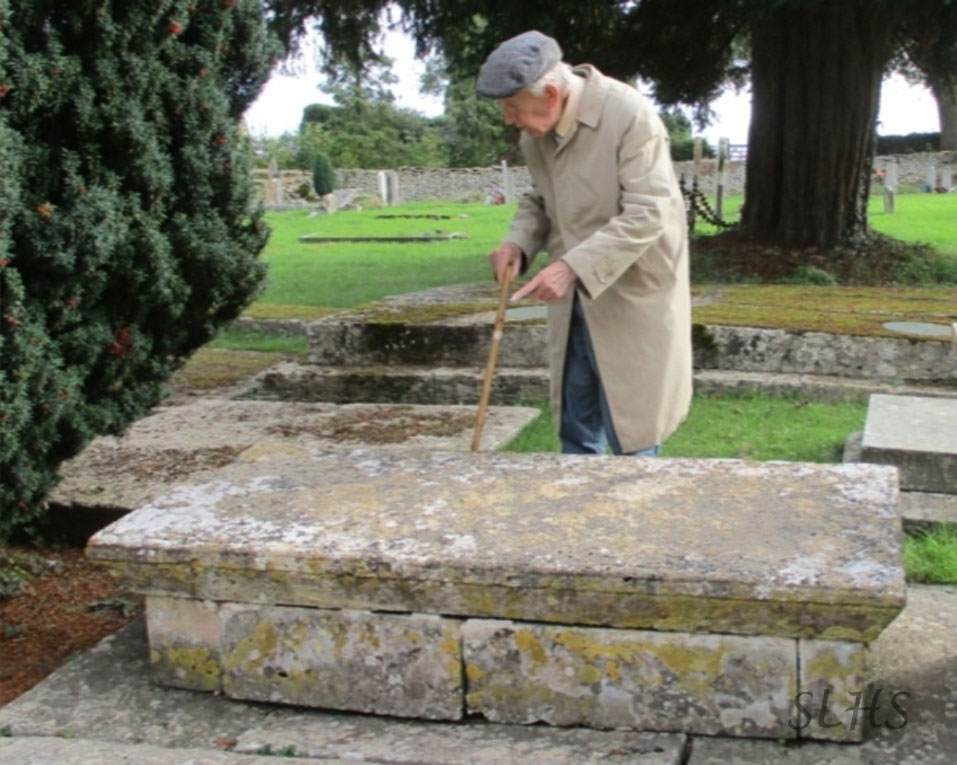
Cowle’s trustees donated their own collections and the museum was only very occasionally opened to the public. In 1936, the Trustees realised they needed professional help and appointed a part-time curator, Mr C I Gardiner. He was quickly consulted on the possibility of moving the museum to the mansion in Stratford Park (bought by the District Council the previous year), but concluded there would be very little benefit and set about organising the collection on the Lansdown site. After he retired Lionel was appointed as the Trust’s first full-time curator in 1955 (asked for a reference, Dr Wallis of Bristol City Museums advised “grab him whilst you can”). Lionel promptly married schoolteacher Olive Lazarus, whom he had met on an archaeological excursion, and they moved to Stroud. Olive helped Lionel with the enormous task of re-labelling every item in the collection. She taught locally and became the organist at St Albans in Parliament Street and when the couple met Wilf Merrett and his wife Betty they were delighted to find they shared a wedding anniversary; the four were good friends for years.
The museum was still only open on certain days and Lionel had a small staff of volunteers to help run it. They included the retired Revd Awdry (who always put his expenses allowance in the donations box) and Stanley Marling, who would also drop in for a chat. Lionel set about publicising the museum with the help of the Stroud News and Journal, which published a series of Introducing Stroud Museum articles with sometimes a whole page of photographs and stories about a particular part of the collection. His delight in his job as curator of a small museum was that he needed to know about a large range of very different objects from a vast timescale, which suited his magpie instincts; no story was too local or tenuous, no tool or utensil too menial. His reputation in vernacular architecture grew as the years passed and he became a Fellow of The Society of Antiquaries and a Fellow of the Museum Association.
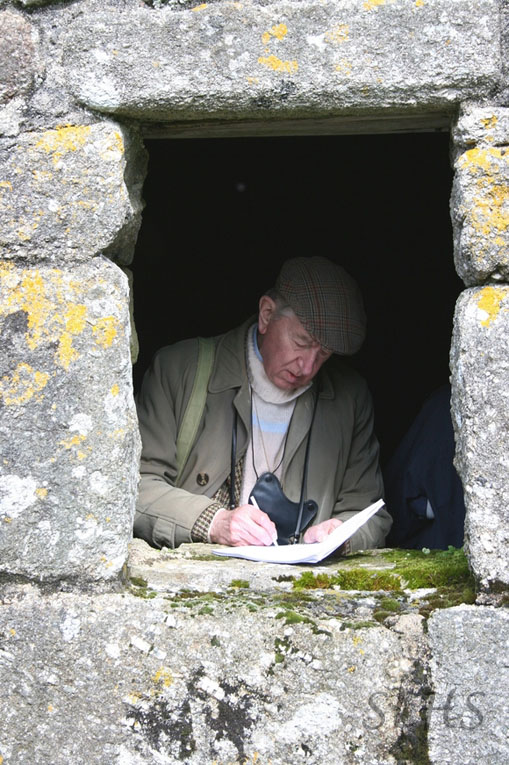
For the next thirty years Lionel expanded the museum’s collection by persuasion and guile, and by his own efforts – walking round town and saving artefacts during demolitions. He also took hundreds of photographs, which now provide an absorbing record of buildings that have since disappeared. In 1984 the management of the museum changed to a joint arrangement between the Cowle Trust and Stroud District Council. Visitor numbers, and donations to the collection, increased significantly as a result of Lionel’s enthusiasm and persistence, his talks to local societies, and to the museum’s more regular opening hours. Lucy Chubb, when Chair of the Friends of the Museum, went with Lionel on some of his expeditions to acquire new artefacts and remembers persuading him not to accept several large farm vehicles. Even so, the collection expanded to such an extent that temporary storage had to be found, including in the empty Union Workhouse at the top of Bisley Road, the space underneath Stroud Public Baths, in Bath Street, and the old brewery buildings in Nailsworth. In 1986 and for a few years, Lansdown Hall was used as a display space for some of Stroud’s larger industrial devices.
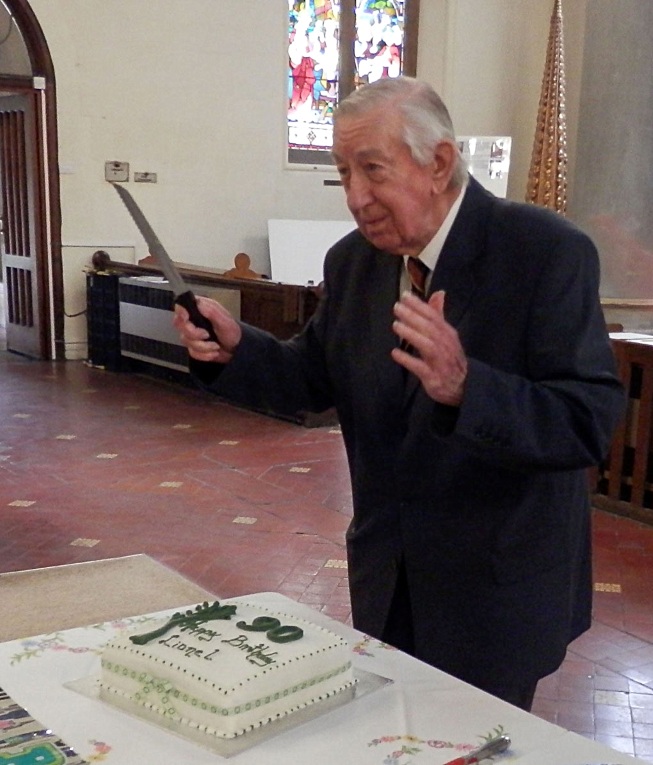
He was an early member of many local amateur history societies (including the Stroud Museum Association and Stroud Local History Society) and he continued his involvement with them throughout his life, particularly the Vernacular Architectural Group (VAG) but also, Stroud Civic Society, the Gloucester Society for Industrial Archaeology (GSIA) – which grew out of a talk by Kenneth Hudson at Wycliffe College – the Cotteswold Naturalists Field Club (of which he was a life member), Bristol and Glos Archaeological Society (BGAS), Glos Building Recording Group, and national societies with similar interests.
Lionel retired in 1992. In his retirement he continued to visit old buildings as both a researcher and an expert consultant. In 2014 co-wrote The Cotswold House with Tim Jordan. In 2018 he was invited to re-visit Low Ham when the site was opened for re-excavation, and in 2019 he joined a Buildings Recording Group tour of Frocester Court, guided by Arthur Price, its owner and his old friend. Lots of people knew Lionel.
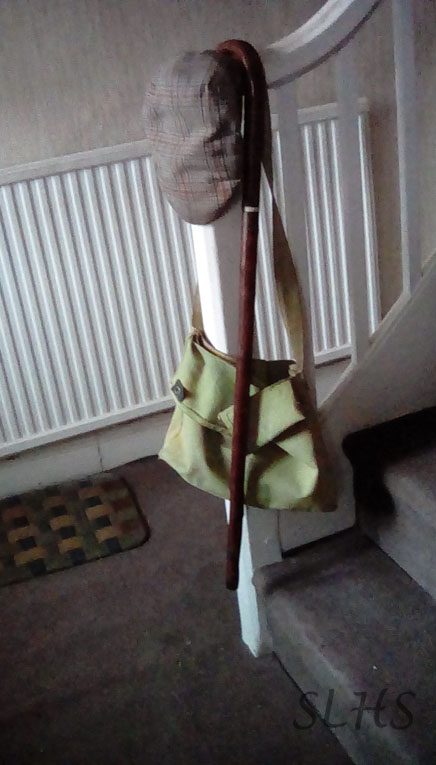
Characteristically, Lionel gave clear instructions about his funeral to his nephew, then still running the family farm, and wrote his own obituary. He rather hoped for a good send-off. Instead, he died in August 2020, during the first of the Covid pandemic lockdowns and his funeral – which would normally have packed St Albans church in Stroud’s Parliament Street – was attended by the maximum of 30 people, including some old friends.
After Lionel died, David Viner (BGAS and many others) and Jane Rowe (CNFC), along with Ray Wilson (GSIA) and Steven Blake (GLHA) helped Stroud Local History Society membersclear Lionel’s house and ensure that everything of historical significance was passed to an appropriate new curator. Several items went to the museum in Taunton or the Museum in the Park, and to organisations with which he was connected. His VAG Field Notes and original papers are deposited at the County Archives in Gloucester and his many photographs have been curated and digitised by Dr Ray Wilson and published online at glosdocs.org.uk as the Lionel Walrond Photographic Collection. His manuscript notes of Stroud stories are in Stroud Local History Society’s collection.